A post by
Thomas Birus
Dipl.-Ing. Food Technology
AI has taken our everyday lives by storm at breakneck speed over the last 2–3 years and has become indispensable in many areas. It is time to take stock, with a focus on the beverage industry – and, in particular, on SMEs within that sector. What potential does AI offer? Where do the risks lie? And what about data protection and cyber security? The article is supplemented by recommendations for action from the German Economic Institute (IW).
Released on 18/08/2026
A post by
Thomas Birus
Dipl.-Ing. Food Technology
The use of AI is regarded as a strategic necessity, but to what extent has it already been adopted and embedded within companies? In May 2026 (according to a report in DIE ZEIT), 47.2 per cent of medium-sized enterprises (50 to 249 employees) were using AI, whilst the figure for micro and small enterprises (up to 49 employees) stood at 51.2 per cent. AI usage is particularly high in the manufacturing and services sectors. Plant manufacturers therefore use AI more frequently than drinks producers. Cost is a decisive factor: three-quarters of companies use paid services from third-party providers, whilst 22.5 per cent use freeware exclusively. Just under one in five businesses utilise systems developed specifically to meet their own requirements.
AI, when used as an operating system, transforms internal processes and creates a modern working environment with higher productivity. It will hopefully also boost staff satisfaction.
One thing that must not be underestimated is that if a new AI is intended to support or even replace existing customer service and does so poorly or to a mediocre standard, this will have a negative impact on customer satisfaction. Service companies in particular should take this to heart and ensure that simple special requests – such as incorporating an email as an appointment reminder into the customer’s status – are possible. (The author of this piece learnt during research for this article that this is by no means a given.)
Thanks to AI and robotics, self-learning systems or proposed solutions for optimising an individual machine or an entire production line are already proving useful. Machine learning for process optimisation is changing the way companies identify risks or sources of error. Complex data is analysed, enabling more accurate predictions to be made or meaningful conclusions to be drawn. In this context, known consequences of errors can be used as data sources (supervised learning), such as poorly applied labels or an illegible best-before date. Unsupervised learning, on the other hand, identifies hidden anomalies in processes.
Particularly in the field of programming, routine tasks or new, simple tasks are carried out by bots. As a result, many jobs that were previously outsourced are no longer required. However, support with complex problems is also considered cost-effective. Significant benefits are expected from the creation of personalised instructions for employees.
Let us take a look together at the near future of the modern workplace. Firstly, the technological foundations of AI are enabling modern workplaces. Key technologies include cloud AI, digital twins and automation solutions. Such applications take over routine tasks, allowing staff to concentrate on more challenging tasks and work more efficiently.
Another area of application is AI-driven decision-making for business processes through intelligent data analysis. AI systems scan through millions of documents and suggest insights that enable managers to make decisions more quickly and accurately. Further benefits include more precise trend forecasts and risk minimisation through the analysis of complex data sets. It is worth emphasising that AI goes far beyond human capabilities!
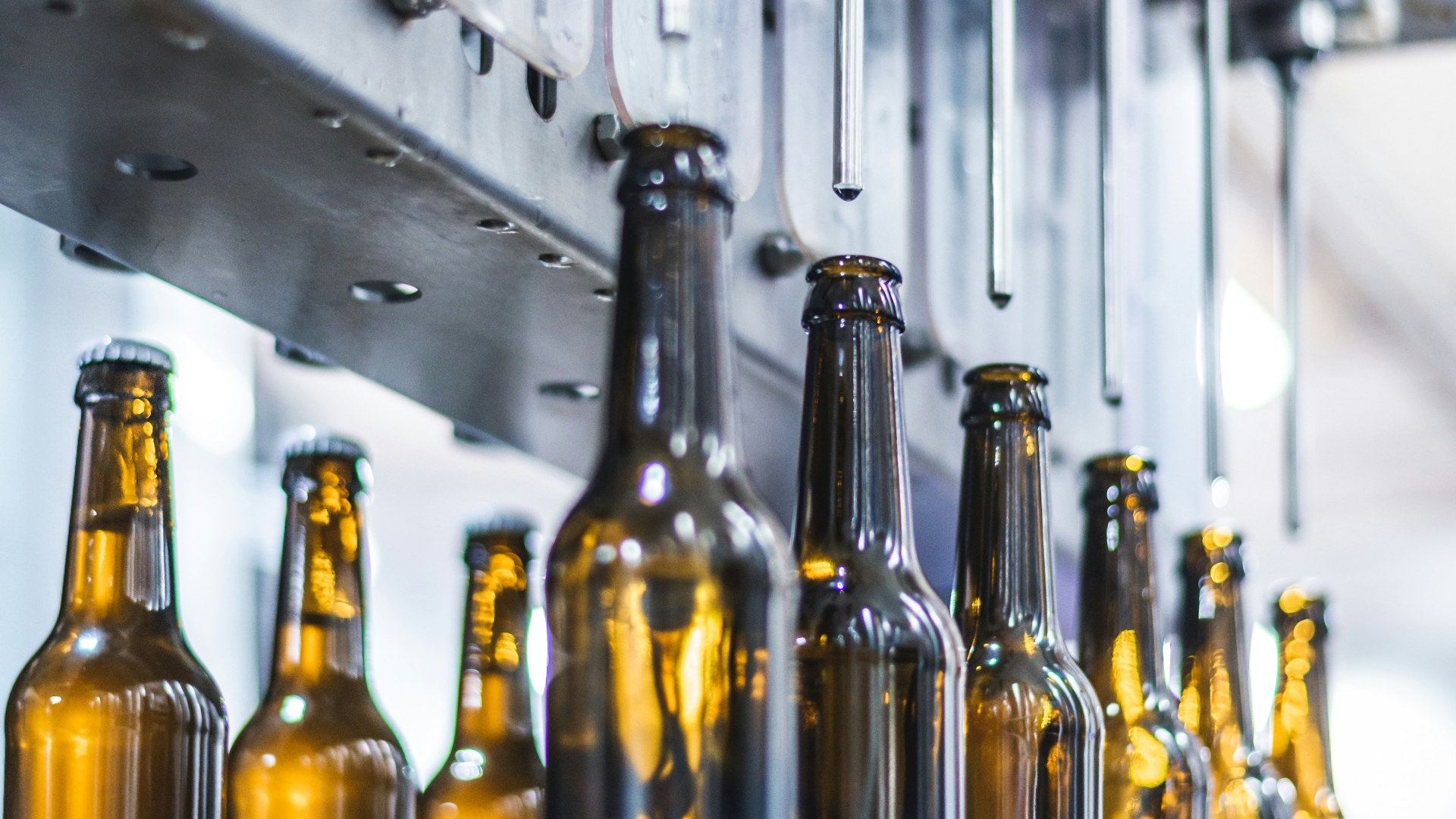
What is already a reality: the design of labels, bottles and cans is made possible by tools such as DALL-E or Stable Diffusion. In recipe development, algorithms evaluate sensory data, market trends and customer reviews. The use of AI applications in the drinks industry does not stop at marketing and product development. AI systems analyse machine, production and sales data in real time. Furthermore, costs are reduced through predictive maintenance, quality assurance in bottling, and lower downtime and wastage.
These are just a few examples of the wide range of applications for AI in the drinks industry. To ensure this potential is realised to the fullest, companies need specialist knowledge and an awareness of the risks involved. After all, only by handling AI with care can we ensure that, amidst all the AI hype, we do not lose sight of the important safeguards.
Which brings us to the topic of AI and the GDPR. When using AI, companies must ensure the protection of sensitive data, compliance with GDPR guidelines and the implementation of security mechanisms. This goes hand in hand with compliance requirements for the secure integration of AI, the anonymisation of personal data, regular security audits and precise documentation of data processing. Compliance with the GDPR is essential for modern businesses and takes on a whole new dimension with the use of AI tools.
The issue of cyber security is also coming into focus for many businesses – now more than ever, with increasingly precise AI-enabled attacks.
In conversation with Barbara Engels, Senior Economist for Sustainable Digitalisation and AI at the German Economic Institute (IW), it becomes clear what matters most when it comes to the key questions surrounding the use of AI in SMEs.
Barbara Engels: Cybersecurity is the key prerequisite for their competitiveness and survival. SMEs in particular are an attractive target because they often possess valuable know-how, yet generally have fewer resources for protection than large companies. With the increasing use of AI, the situation is becoming doubly acute: on the one hand, AI applications open up new vulnerabilities – for example, by feeding sensitive data into external systems – whilst, on the other hand, attackers are also using AI to make phishing and malware more sophisticated. A successful attack can quickly threaten the very existence of an SME.
Barbara Engels: First and foremost, AI should be deployed selectively where there is a clear benefit. It is crucial to consider AI implementation and security together right from the start. Specifically, a policy is recommended that clearly regulates which data may be fed into which AI systems. Raising awareness and training staff are of paramount importance, as people remain the most common point of entry for attacks, as is the implementation of basic technical hygiene measures such as updates, backups and access controls. SMEs do not have to tackle this alone – partnerships, industry associations and external service providers can compensate for any lack of in-house expertise.
Barbara Engels: The legal framework is currently shaped largely by the EU’s AI Regulation (AI Act), which strictly regulates applications according to their risk class. Added to this are data protection (GDPR), liability and copyright issues, as well as the protection of trade secrets. For SMEs, the challenge lies less in the content of the regulations themselves than in the effort required for implementation: documentation and transparency obligations tie up resources that are in short supply in smaller businesses. It is therefore important to clarify at an early stage which risk class one’s own applications fall into, and to view legal certainty not as an obstacle but as a basis of trust with customers and partners.
In summary, it can be said that digital transformation is changing businesses and the way they operate. AI enables risks to be identified at an earlier stage. Businesses need technical solutions and must, above all, recognise what is ethically and legally correct. Success stems from innovation and responsibility. Those who invest in AI in good time will reap the benefits. It is important to continue learning and to remain flexible. However, at the same time, the creative individual remains irreplaceable. The interface between humans and machines will therefore endure.
Sources:
The use of AI in businesses; DIE ZEIT weekly newspaper, 5 June 2026
https://ki-trainingszentrum.com/
Machine translated
Experience database
A post by Markus Windisch

Quality assurance
A post by Dr. Jürgen Hofmann

Process control
A post by Klaus Vette

precision fermentation
A post by Lucia Baier
