A post by
Thomas Birus
Dipl.-Ing. Food Technology
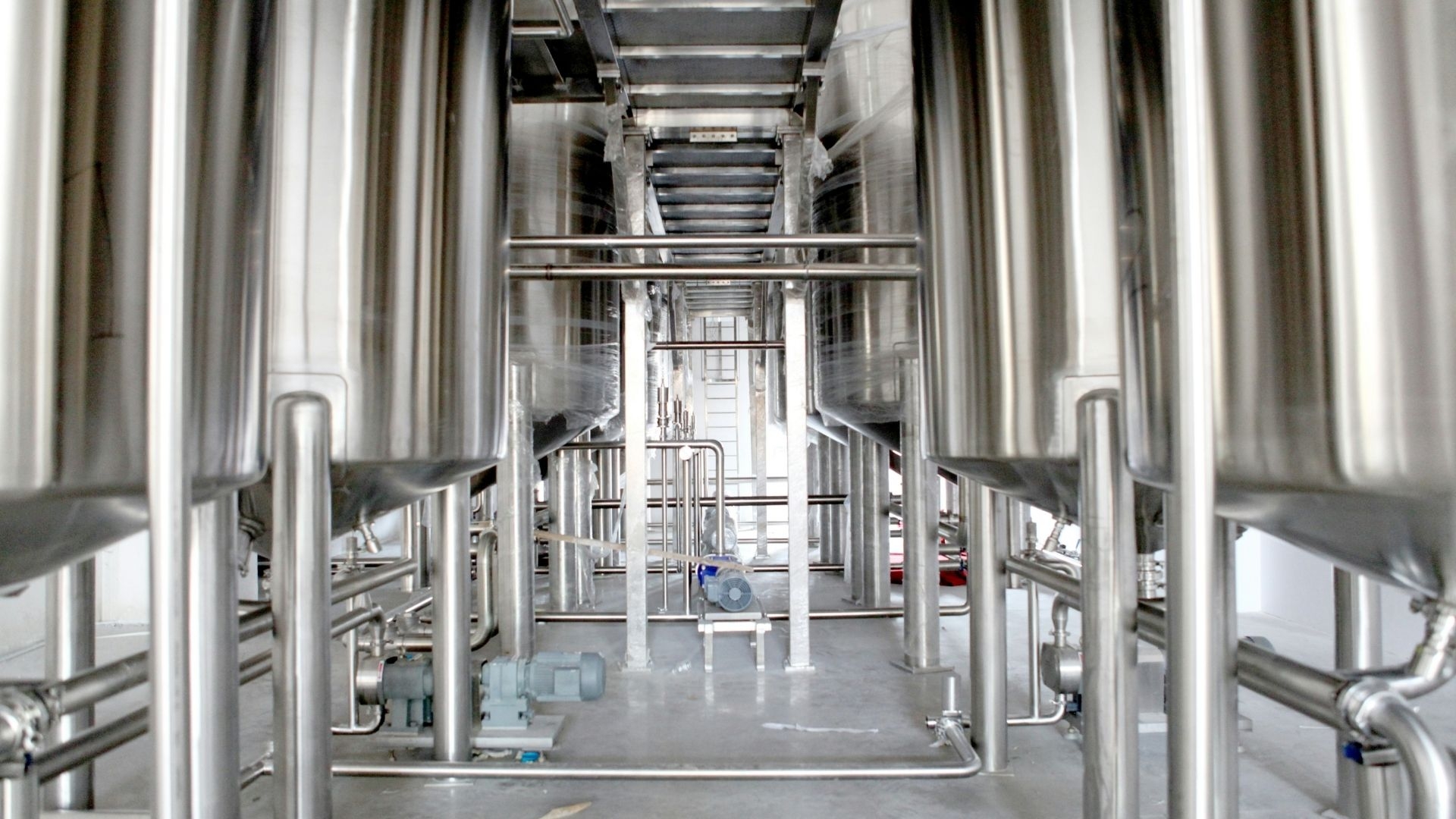
Beverage manufacturers spend 15-20% of their daily operating time on cleaning. A CIP system requires enormous amounts of water, chemicals and energy. Depending on the industry (beer, mixed drinks, milk, vegan drinks), energy requirements vary, but are around 10% for the CIP system alone. In addition, meeting hygiene standards often accounts for more than 15% of a company's total water consumption. Regular testing and optimisation of the CIP system is essential to keep water and energy consumption as low as possible. This article provides an overview of the most important parameters of CIP systems and possible adjustments for optimising cleaning.
Released on 16/01/2026
A post by
Thomas Birus
Dipl.-Ing. Food Technology
In production plants, special fixtures such as spray balls or targeted jet cleaners in tanks and sufficiently dimensioned pumps provide the necessary flow forces for cleaning. The term generally used for this is CIP, which stands for cleaning-in-place. In SIP (sterilisation-in-place), the system or tank is sterilised with saturated steam for 30 minutes, for example, and then blown out with cold sterile air. SIP always requires a functioning CIP system.
Batch cleaning is used in medium-sized and large companies and allows cleaning solutions to be reused, intermediate rinse and final rinse water to be collected, and further optimisation, primarily to save time and reduce costs.
With this technology, the pipeline is first emptied. Air and water pulses are then shot into the pipeline. Compared to conventional water flushing at 2 m/s, the flow velocities generated are up to ten times higher at up to 20 m/s. Comprex technology accelerates water plugs in less than 0.1 seconds. As a result, increased shear forces dissolve biofilms just as quickly and thoroughly as stubborn product residues, even without the addition of chemicals.
Vincent Hammann, Managing Director of Comprex Engineering GmbH, also sees a reduction in wastewater volume due to the significant water savings (up to 90 per cent). This also minimises the energy consumption of temperature-controlled cleaning fluids. This saves costs and results in shorter downtimes. ‘Compared to previous rinsing methods, we achieve very good results with fruit juice-like consistencies – whether thin or concentrated – but also with drinking yoghurts and vegetable juices, for example,’ emphasises Vincent Hammann.
Ruland Engineering has already successfully integrated this technology into the CIP cleaning of toothpaste production lines. Managing Director Bernhard Scheller also sees great potential for its use in classic CIP systems.
Before cleaning, the product must be completely removed (use pigging technology if necessary). The cleaning solutions must be available in the required concentration and temperature. Chemical concentrates for re-sharpening the solutions are also available in sufficient quantities.
Measuring sensors and signal lines are checked for functionality and accuracy. Valves and pumps should undergo regular maintenance. Safety features in the control system ensure that the desired pressures and volume flows, cleaning times, temperatures and concentrations are also achieved at the end of the plant parts to be cleaned.
The volume flow and pressure of the cleaning feed pump should be sufficient to ensure that the tank interior is completely flooded. The minimum flow velocity in pipes is at least 2 m/s. The pump pressure should be between 3 and 7 bar. Flow measurement is therefore of fundamental importance for an efficient CIP system. The desired cleaning effect is achieved by ensuring a strong and turbulent flow.
In view of rising costs, it always makes sense to take a closer look at the CIP system and implement optimisation measures. Inline process measurements support food manufacturers in switching from time-based to real-time monitoring systems. These systems ensure the desired cleaning efficiency as well as reduced operating costs and lower losses.
The accuracy of phase separation during the transition from rinsing water to cleaning agent and vice versa is based on data-supported decisions. This means that you know exactly which medium is in the production line. High-quality optical sensors with fast response times detect the start and end of each phase of a CIP cycle. This reduces product losses and at the same time minimises the risk of media mixing. This enables savings through shorter cleaning cycles, lower water and chemical consumption, and minimised product losses.
Additional fittings and sensors can create dead spaces. Cleaning may be insufficient in these areas. Concentration sensors for cleaning agents must not have any dirt deposits, as this increases electrical resistance. The measured concentration now appears to be lower than the actual concentration, leading to an overdose of cleaning agents. Monitoring the formation and removal of deposits is therefore essential for product safety and quality. If changes are made to the system, revalidation is required. Regular revalidation is always recommended!
When cleaning tanks, there should be a balance between the amount of liquid supplied and the amount pumped out. This prevents sludge from forming with residues at the tank outlet. This can be achieved with a centrifugal pump whose speed and thus the volume flow are continuously regulated by a frequency converter.
The built-in spray balls ensure sufficient overflow in the tanks. Care must be taken to ensure that the cleaning jet is well focused with a long range without misting (no burrs on the holes of the spray balls) and that it is positioned correctly (no spray shadows or blind spots). Otherwise, this will result in deposit build-up in individual areas due to spray shadows. This can be remedied by monitoring the pressure of the cleaning feed pump. Target jet cleaners as rotating elements are an alternative for tank cleaning.
Beverage manufacturers often rely on a time-controlled cleaning system. Perhaps the most important practical observation is that fully automated CIP does not provide any visual control. The screen simply says: Cleaning of tank A completed, and this is routinely equated with proper CIP. This can be a fallacy in the case of new products such as vegan drinks or mixed beverages. For this reason, a heat exchanger or tank should be inspected regularly for control purposes.
Precise temperature measurement and control ensures that cleaning agents work as intended, microbiological risks are eliminated and hygiene standards are met. This protects equipment, maintains product quality, optimises chemical use and increases energy efficiency.
The asynchronous control of valves and pumps can be avoided by using intelligent system control. In the case of valves, the question of leak safety must be addressed. Cyclical cleaning and rinsing inevitably results in losses, which incur costs. Sometimes, insufficient control air pressure – especially when many valves switch at once – can also lead to an error in the cleaning programme. A displaced initiator also leads to an error message.
Company management often argues that ‘replacing/building a new CIP system is not cost-effective’ because it means that no more product is filled into containers, thus focusing purely on the cost side. Valentin Jörns, owner of bawaco gmbh, points out that the total failure of a CIP is not taken into account here! In the event of such a total failure, e.g. due to an outdated control system and/or defective tanks, no production takes place and the price for systematic maintenance of the system and the functional reliability of the control system is significantly lower than the cost of a production shift failure.
Furthermore, there should be no fear of optimising or converting the existing CIP system. A retrofit involving a control system replacement combined with a modernisation of the measurement and control technology quickly contributes to a significant extension of the service life. According to Valentin Jörns, the aspect of occupational safety within a CIP system also deserves much more attention.
For new products such as vegan drinks, cleaning times or throughput quantities are increased in order to reliably remove fouling induced by protein denaturation. Sales of such drinks are now declining. The product may no longer be available, but the volume flow is still not reset to a reasonable value. True to the motto: We've always done it this way.
The cleaning success can be checked visually for dirt residues or insufficient wettability of the surface. Microbiologically, sterility is tested by swabbing, rinsing with nutrient solution or contact sampling. The ATP rapid determination indirectly checks whether any remaining microorganisms cause an increased value and thus a short additional CIP is advisable.
Overall, CIP remains a perennial favourite, with constant adjustments to the required cleaning parameters and ongoing modernisation of measurement technology and automation.
Sources
T. Birus: Modern operating technology in the food and pharmaceutical industries (confructa medien)
Endress+Hauser.com: CIP in the food industry
Comprex.de: the Comprex process
Quality assurance
A post by Dr. Jürgen Hofmann
Process control
A post by Klaus Vette
Denmark leads the way
A post by Gustav Arnt Juul
Data collection
A post by Christoph Nophut
