A post by
Dr. Ramón Heidinger
Head of department
Staatliches Weinbauinstitut (WBI) Freiburg
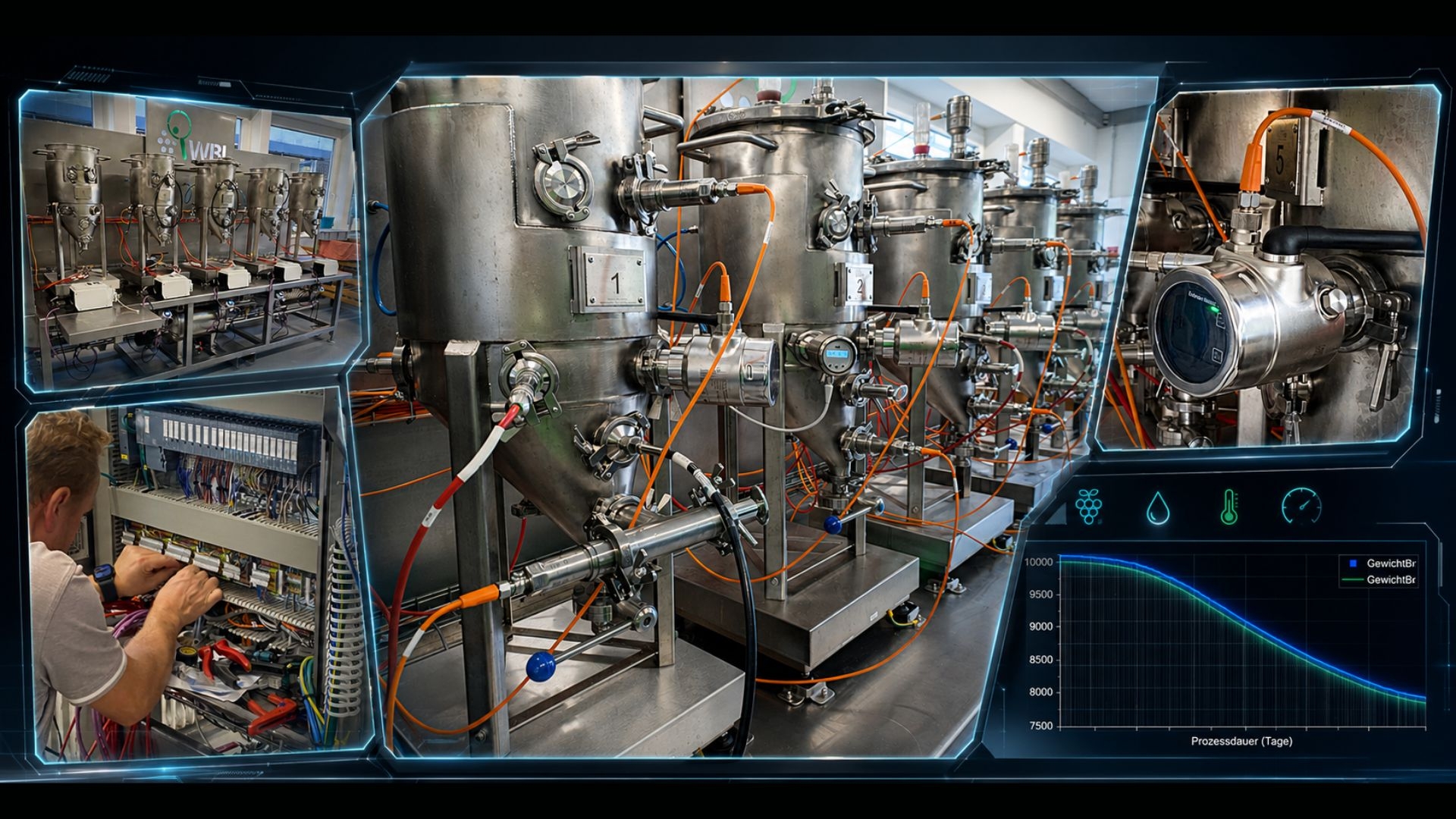
At the State Institute of Viticulture (WBI) in Freiburg, an experimental facility is being developed to make fermentation processes more transparent, safer and easier to control: the AI Winery. At BrauBeviale, we will be showing brewers, winemakers, plant engineers and biotechnologists how hygienic tank design, sensor technology, open communication, automation and artificial intelligence come together to form a practical research platform. The aim is to turn measured data into fermentation processes that are more predictable and better documented, whilst also enabling new approaches to digital process control.
Released on 14/08/2026

A post by
Dr. Ramón Heidinger
Head of department
Staatliches Weinbauinstitut (WBI) Freiburg
Fermentation is a complex microbiological process in wine, beer and beverage production. A wide range of parameters – temperature, microbial activity, oxygen supply, pressure, turbidity, conductivity, substrate concentrations, etc. – are all relevant. In practice, these interrelationships are often monitored off-line, i.e. via tank samples, individual measurements and experience. The situation becomes critical when deviations are detected too late, laboratory results are delayed, or multiple vats need to be monitored simultaneously.
This is precisely where the KI Winery comes in. It visualises fermentation dynamics in real time and lays the foundation for making decisions earlier and with greater confidence. Oenological or brewing expertise is combined with continuous process data, enabling unusual process developments, changes in yeast performance or fermentation stalls to be detected and assessed more quickly.
For the AI Winery, dedicated fermentation tanks were planned, designed and integrated into a modern automation environment at the WBI Freiburg. The plant design is optimised for hygienic connections, CIP capability and both hot and cold sterilisation. This allows experiments to be carried out under conditions that are of interest to research whilst maintaining a clear link to operational practice.
The platform was developed in collaboration with the tank manufacturer Destiltec and the automation specialist Aktech. Its structure is based on the concept of an open research infrastructure. Different sensor concepts, data sources and automation modules can be integrated, compared and further developed – for applications ranging from wine and beer to non-alcoholic fermentations and specialised applications in the drinks industry.
A key focus is on integrating industrial sensor technology from various manufacturers. The AI Winery utilises sensors from Hamilton, IFM, Endress+Hauser, SELI and JUMO, amongst others. Parameters measured include temperature, conductivity, pressure, level, dissolved oxygen, density, viscosity and cell-related signals (turbidity, impedance, ORP).
The system deliberately relies on open, industry-grade communication protocols such as Profinet, Industrial Ethernet, Modbus, OPC UA, serial interfaces and traditional field signals. This ensures that no isolated data silos are created. The information is consolidated, visualised, stored and prepared for subsequent analysis within a central control and data environment. This openness is crucial because it allows measurement principles and analysis strategies to be evaluated independently of the manufacturer.
The platform’s true strength lies in the integration of online data, laboratory analysis and process knowledge. During a test run, data sets are generated containing timestamps, target and actual values, temperature and weight trends, pressure readings, conductivity, radar level, dosing information and other sensor signals. These can be supplemented with laboratory parameters such as density, sugar, alcohol, acidity, pH, sulphur dioxide, live cell counts or yeast-utilisable nitrogen.
This diversity of data makes it possible to better understand process behaviour, to compare sensor signals with analytical references, and to develop models that highlight critical developments at an earlier stage. Artificial intelligence can recognise patterns that are difficult to discern in individual measurement values: slow drift, unusual combinations of several parameters, or deviations from known fermentation profiles.
In the long term, this could lead to the development of a learning system that supports plants with tank inspections, interventions and documentation. Potential applications include biomass propagation, non-alcoholic fermentation, quality assurance and new process strategies. The benefit lies in translating the data into actionable information that can influence, for example, aeration, temperature control or nutrient management.
Another important aspect is knowledge transfer. The AI Winery is not only intended to collect measurement data, but also to demonstrate which combinations of tank design, sensor technology and automation are truly effective under real-world conditions.
This will enable complex research set-ups to be translated, in future, into simplified, robust and affordable solutions for businesses. Small and medium-sized enterprises in particular stand to benefit if digital process control is not conceived as a closed, specialised solution, but can instead be integrated into existing cellar and production workflows in a modular, transparent and step-by-step manner.
BrauBeviale is the ideal venue for us because it brings together the entire drinks industry: brewers, winemakers, machinery and plant manufacturers, automation specialists, sensor suppliers, research institutions and users from a wide variety of businesses. A platform like the AI Winery needs precisely this kind of exchange. Many of the questions being investigated in Freiburg using fermentation as a case study also arise in similar ways in breweries, in other fermentative processes, and in the production of non-alcoholic drinks and spirits.
We would therefore like to put a concept up for discussion at the trade fair. Which sensors provide reliable information in day-to-day operations? Which data helps with decision-making, and which merely creates extra work? How open do interfaces need to be for research findings to be implemented in businesses? And what role can AI play when processes are biologically complex, vary from one business to another and are critical to quality?
The AI Winery sees itself as a bridge between research, plant engineering, sensor technology and operational application. It aims to demonstrate how digital process control in the drinks industry can be approached in a practical way: hygienic, interoperable, manufacturer-independent and closely aligned with real-world production challenges. In Nuremberg, we would like to showcase this approach and develop it further with all interested parties.
Collaboration: Fabio Fehrenbach, Staatliches Weinbauinstitut Freiburg
Machine Translated
Dealcoholization
A post by Nina Anika Klotz

Quality assurance
A post by Dr. Jürgen Hofmann

Non-alcoholic wine
A post by Dr. Matthias Schmitt
Process control
A post by Klaus Vette
